Editorial note: This evidence-led explainer uses the linked primary sources and original AI New analysis. It is educational, not legal, medical, financial or procurement advice; verify current requirements with qualified professionals.
The signal: machine learning in climate science
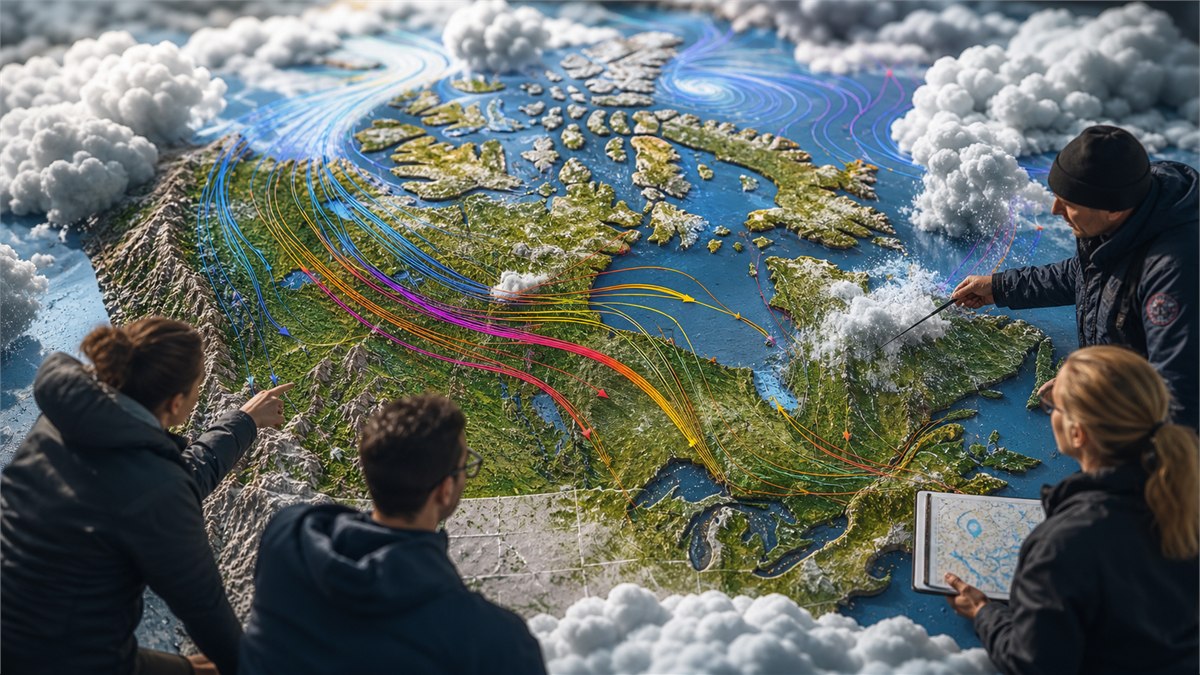
The research signal deserves attention, but the headline becomes useful only after its evidence and limits are kept together. AI can accelerate parts of climate modelling and translate coarse signals to local scales, but it cannot remove uncertainty about emissions, physics or future extremes. That distinction is the centre of this article. It tells us what deserves attention, what can be tested now, and which claims should remain provisional. AI coverage often collapses a system into the name of a model or a dramatic demonstration. In practice, outcomes emerge from people, data, interfaces, incentives and operating conditions as much as from a set of weights.
AI weather and scientific-computing research demonstrates faster predictive systems, while climate applications increasingly combine learned and physical models. This is credible primary-source evidence about direction, design or stated results. It is not universal proof. The responsible move is to translate the claim into observable questions and compare it with the setting in which a reader might act. Throughout this guide, factual descriptions stay connected to the source list, while recommendations are clearly presented as analysis.
What the primary evidence establishes
The strongest reading combines the named primary sources rather than relying on a single announcement. One source defines the capability or policy, another supplies a risk or implementation lens, and the article's analysis connects them to a realistic decision. That triangulation cannot remove uncertainty, but it makes assumptions easier to see and update.
The evidence supports a focused conclusion: AI weather and scientific-computing research demonstrates faster predictive systems, while climate applications increasingly combine learned and physical models. It does not establish that every user, organization or region will see the same outcome. Product versions, access rules, prices, laws and local conditions change. Readers should use the publication date and linked sources to check time-sensitive details before making a consequential choice.
- Supported signal: AI can accelerate parts of climate modelling and translate coarse signals to local scales, but it cannot remove uncertainty about emissions, physics or future extremes.
- Evidence boundary: Training data represents a changing climate imperfectly, local extremes are rare and a sharp-looking map can imply precision the evidence does not support.
- Reader task: separate demonstrated capability from dependable performance in your own context.
How the system works
Models learn relationships between large-scale atmospheric states and local patterns or approximate expensive simulation components. Thinking in components is more than a technical exercise. It shows where evidence can be collected and where control can be added. Inputs can be checked for authority and permission; retrieval can be tested for coverage; generated output can be validated; tools can be constrained; and a human decision can be documented.
A useful system map follows one item from beginning to end. Identify who supplies it, what transformation occurs, which model or service is involved, what gets stored, who sees the result and what happens next. Then mark every point where a wrong or delayed result could change the outcome. This prevents an impressive interface from hiding a fragile process and gives non-technical reviewers a concrete way to participate.
Where the value can be real
Retain scenario labels, compare multiple models, validate extremes separately and communicate ranges tied to the actual infrastructure or adaptation decision. This is deliberately narrower than a promise to transform everything. A bounded use case has a recognizable starting state, a responsible owner and a result that can be compared. It also creates a place for workers and affected users to describe quality in terms that matter to them rather than accepting a vendor's benchmark as the only definition.
Value should be counted after the whole workflow settles. Include time spent preparing data, reviewing output, correcting errors, handling exceptions, integrating systems and supporting users. Also count changes in cycle time, accessibility, consistency, capacity and risk. A tool may be worthwhile even when it does not reduce headcount; it may let a small team provide a service that was previously delayed or unavailable. The claim should match the measured benefit.
- Keep scenario and model uncertainty visible.
- Validate tails, not only average weather.
- Match map resolution to evidence resolution.
Limits and failure modes
Training data represents a changing climate imperfectly, local extremes are rare and a sharp-looking map can imply precision the evidence does not support. This is not a footnote. It defines the conditions under which the article's recommendation should change. Every AI system has an operating envelope: the tasks, users, data and environments for which evidence exists. Problems begin when a successful example is silently extended beyond that envelope.
Failure is rarely one dramatic event. More often it appears as small unsupported claims, uneven quality across groups, stale information, review fatigue, rising cost or a workaround that becomes permanent. Track those signals before they become normal. Preserve representative errors, investigate causes across the complete system and change the workflow instead of repeatedly asking users to be more careful around a bad design.
A practical playbook
Begin by writing the intended outcome in one sentence and naming the person accountable for it. Record the current baseline, select representative examples and define errors that are unacceptable even if average quality is high. Keep the first version reversible. Limit data, permissions, users and duration, and make the fallback path usable rather than ceremonial.
Run the test long enough to encounter ordinary pressure: busy periods, ambiguous inputs, absent staff and source changes. Review results with the people who perform the work and people affected by it. Decide to scale, revise or stop against criteria written before the result was known. If the system advances, keep the evaluation suite, incident route and ownership structure with it.
- Keep scenario and model uncertainty visible.
- Validate tails, not only average weather.
- Match map resolution to evidence resolution.
- Record the model, prompt, source and policy versions used in the decision.
- Schedule a review date instead of assuming the first approval remains valid forever.
A worked decision frame
Imagine a team deciding what to do about machine learning in climate science. One group sees a reason to move quickly; another sees reasons to wait. Instead of voting from impressions, turn the disagreement into a written decision: the proposed use, the people affected, the expected benefit, the evidence available now and the result that would make the team reverse course. Then connect that decision to the article's central finding: AI can accelerate parts of climate modelling and translate coarse signals to local scales, but it cannot remove uncertainty about emissions, physics or future extremes.
Stress-test the proposal with the most important boundary: Training data represents a changing climate imperfectly, local extremes are rare and a sharp-looking map can imply precision the evidence does not support. Ask the team to show how retain scenario labels, compare multiple models, validate extremes separately and communicate ranges tied to the actual infrastructure or adaptation decision. would operate on an ordinary day and during a difficult edge case. A credible plan should reveal its data, review load, fallback, incident owner and exit path. If those elements cannot be demonstrated at pilot scale, increasing model capability or purchasing a broader licence will not repair the missing operating design.
Questions worth asking before you act
Good questions slow down the part of a project that is cheap to change and speed up the part that would otherwise fail in production. They also distribute expertise: a lawyer, operator, researcher, worker or user may see a different weak point in the same workflow. The following questions are intentionally concrete enough to require evidence rather than reassurance.
Do not accept "the model is accurate" or "a human is in the loop" as complete answers. Ask for the task definition, test population, error distribution, reviewer authority, data flow, model version and recovery path. If the team cannot produce that information, the gap is itself a finding and should narrow the deployment until evidence exists.
- Which uncertainty dominates this decision?
- Does the model extrapolate beyond its climate history?
- Would another method change the adaptation choice?
What to watch next
The next useful signals are physics-informed hybrids, extreme-event calibration, open regional datasets and evaluations based on adaptation outcomes. Each can be observed without predicting a distant artificial-general-intelligence milestone. They show whether capability is becoming dependable infrastructure, whether safeguards operate under pressure and whether benefits reach the people named in the announcement.
Update your view when the evidence changes. Product names and benchmark leaders will move quickly; the more durable questions concern authority, measurement, reversibility and who carries the downside of error. Bookmark the primary sources below, compare new announcements with this article's decision framework and prefer documented outcomes over confident forecasts.
The bottom line
AI can accelerate parts of climate modelling and translate coarse signals to local scales, but it cannot remove uncertainty about emissions, physics or future extremes. The practical consequence is equally clear: Retain scenario labels, compare multiple models, validate extremes separately and communicate ranges tied to the actual infrastructure or adaptation decision. That combination of ambition and verification is the most useful way to engage with fast-moving AI. It leaves room for genuine advances without treating uncertainty as a reason for either hype or paralysis.
Use this article as a working brief. Take the action list into a project meeting, replace assumptions with local evidence and record what would make the decision change. When the underlying source, model or policy is updated, revisit the relevant section rather than carrying an old conclusion forward. High-quality AI practice is not certainty; it is a disciplined ability to learn and correct course.
Continue with the original sources
These first-party and primary references support the reporting above. Open them for technical detail, current requirements and subsequent updates.
See something we should fix or clarify? Read the corrections policy or tell the newsroom. Material changes are noted here.