
Editorial note: This AI-generated article was manually copied from AutoSEO. Its wording and cited links are preserved. It has not completed AI New Canada’s source review and remains outside search promotion. Check current primary sources before relying on legal or policy claims.
What if an AI term describes how a system works in one document, but who is responsible for it in another? If you’ve encountered phrases such as “automated decision-making,” “high-impact AI” or “responsible AI” without clear definitions, the confusion is understandable. In Canada, technical concepts, governance practices and legal obligations can use similar language without meaning the same thing. A practical ai glossary canada readers can use should clarify those differences, not blur them.
This guide explains essential AI terms in plain language and shows you how to check what they mean in context. A proposed law, a directive that applies to federal institutions and a voluntary standard don’t carry the same force. Treating them as interchangeable can lead to mistaken conclusions about what an organization must do. Since the status of a law or policy can change, definitions alone aren’t enough.
Use this glossary as a starting point. It covers technical concepts, governance and legal language, plus practical ways to verify definitions and policy status against credible Canadian sources. The goal is to help you connect each term to the system, evidence and accountability it actually describes.
Key Takeaways
- Use an ai glossary canada as a reference for clarifying terms, not as a compliance test or substitute for primary sources.
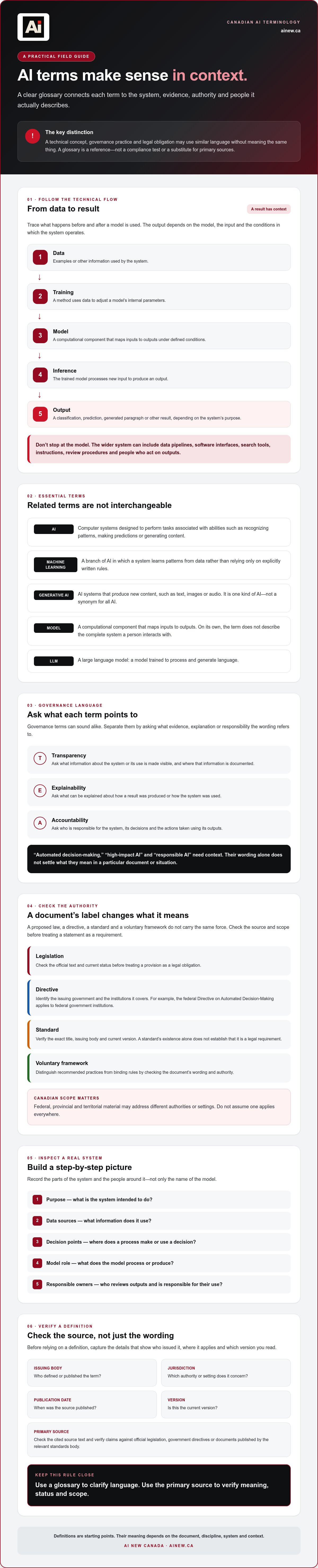
- Trace how data moves through training, inference and output to see what each technical term describes in practice.
- Separate governance concepts such as transparency, explainability and accountability by asking what evidence or responsibility each one points to.
- Inspect a system step by step, recording its purpose, data sources, decision points, model role and responsible owners.
- Check Canadian AI definitions against the issuing institution, jurisdiction, publication date, version and cited primary sources.
Table of Contents
- What an AI glossary in Canada should clarify before you use a term
- Core AI glossary terms: models, data, training, and outputs
- Canadian AI governance glossary: impact, transparency, and accountability
- How to use AI terminology to inspect a real system
- Where to find and verify Canadian AI definitions and resources
What an AI glossary in Canada should clarify before you use a term
An AI glossary is a reference that explains artificial intelligence terms and shows how their meanings depend on context. It helps readers interpret technical and policy language, but it isn’t a compliance test or proof that a system meets a legal requirement. An AI glossary can clarify a term, but no single entry settles what that term means in every document or situation.
That distinction matters in an ai glossary canada. A technical paper may use “model” to describe a system that processes inputs and produces outputs, while a policy document may focus on a system’s impact or the people responsible for its use. In everyday conversation, the same term might be used more loosely. Treat definitions as starting points, then check the surrounding text.
How to read an AI definition without losing its context
First, identify what the term describes: a technology, process, impact or obligation. Then check who defined it and which discipline or document the definition comes from. If a term has multiple accepted meanings, a useful glossary should flag that variation rather than present one meaning as universal. For foundational technical vocabulary, Wikipedia’s alphabetized Glossary of artificial intelligence can help orient readers. It does not establish Canadian legal or policy meanings.
Why Canadian AI terminology needs source labels
Canadian relevance depends on more than a term’s wording. Record the issuing body, jurisdiction, publication date and source text, then confirm that the document applies to the system or organization in question. Federal material and provincial or territorial material may address different authorities or settings, so don’t assume one applies everywhere.
- Legislation: Check the official text and current status before treating a provision as a legal obligation.
- Directive: Identify the issuing government and the institutions it covers. For example, the federal Directive on Automated Decision-Making applies to federal government institutions.
- Standard: Verify its exact title, issuing body and current version. A standard’s existence alone doesn’t establish that it is a legal requirement.
- Voluntary framework: Distinguish recommended practices from binding rules by checking the document’s wording and authority.
Verify claims against primary sources, such as official legislation, government directives or documents published by the relevant standards body. A glossary can guide your search, but it can’t replace the source text or determine how a rule applies to a particular case.
Core AI glossary terms: models, data, training, and outputs
Start with the basic distinctions. Artificial intelligence (AI) describes computer systems designed to perform tasks associated with abilities such as recognizing patterns, making predictions or generating content. Machine learning is a branch of AI in which a system learns patterns from data rather than relying only on explicitly written rules. Generative AI refers to systems that produce new content, such as text, images or audio. It’s one kind of AI, not a synonym for all AI.
A model is a computational component that maps inputs to outputs under defined conditions. A large language model (LLM) is a model trained to process and generate language. Neither term, on its own, describes the complete system a person interacts with.
What are a model, training, and inference?
Follow the sequence. Data provides examples or other information. During training, a method adjusts a model’s internal parameters using that data. During inference, the trained model processes new input to produce an output. Depending on the system’s purpose, that output might be a classification, prediction, generated paragraph or other result.
An AI output depends on the model, the inputs it receives and the conditions under which the system operates. Identifying the model alone isn’t enough to explain a result.
An AI system can also include data pipelines, software interfaces, search tools, instructions, review procedures and people who act on its outputs. For example, a language model may draft a response while another tool retrieves documents and a staff member checks the draft before using it. The model generated text; the wider system shaped the input, and the human process determined what happened next.
How generative AI, LLMs, prompts, and hallucinations differ
A prompt is the instruction or context supplied as input to a generative model. It can guide the requested task, but it doesn’t establish that the response is accurate. A hallucination is an inaccurate or unsupported output presented as though it were reliable. Fluent wording is not evidence. Check factual claims against source material, especially when the result may inform a decision.
For the ai glossary canada reader, keep each term attached to the part of the system it describes: generative AI identifies a type of capability, an LLM identifies a model category, and a prompt identifies an input. For Canadian governance terms that may arise when examining a system’s use, consult the Canadian AI Governance Glossary alongside the original source documents. You can also explore Canadian AI glossary and resource directory for further terminology and reference material.
Canadian AI governance glossary: impact, transparency, and accountability
Governance terms describe different questions about how an AI system is assessed, used and overseen. They can overlap, but they aren’t interchangeable, and using a term doesn’t automatically create a legal duty. In an ai glossary canada, each definition should point to the question it helps investigate and the kind of source that gives it authority.
| Term | Question it helps investigate | Source type to check |
|---|---|---|
| Algorithmic impact assessment | What effects or risks could arise from this system’s use? | Directive, policy or assessment framework |
| Automated decision-making | Does a system make or support a decision about a person or case? | Legislation, directive or policy |
| Transparency | What information about the system and its use is disclosed? | Legislation, guidance or standard |
| Explainability | Can a particular output or system behaviour be understood? | Technical documentation, guidance or standard |
| Accountability | Who owns decisions, controls, records and remedies? | Legislation, policy or governance framework |
| Bias | Could data, design or use produce systematically unfair results? | Technical evaluation, guidance or standard |
These source types are clues, not a ruling on legal effect. Check the document’s issuer, scope and wording. The Government of Canada’s Guide on the use of generative artificial intelligence, for example, is federal guidance. Read it as guidance rather than assuming it applies as legislation to every organization.
How an algorithmic impact assessment differs from an audit
An algorithmic impact assessment is a structured examination of potential effects and risks, often before or during deployment. An audit examines evidence against stated criteria, controls or requirements. An assessment may identify risks; an audit may test whether specified practices were followed.
A risk-assessment process identifies and evaluates potential effects; a legal requirement exists only when an applicable source makes it mandatory. In Canada, the federal Directive on Automated Decision-Making requires an Algorithmic Impact Assessment for federal institutions within its scope. That example doesn’t establish a general requirement for every Canadian organization to conduct one.
What transparency, explainability, and accountability each ask
Keep the questions distinct. Transparency concerns what is disclosed about a system and its use. Explainability concerns how a specific output or behaviour can be understood. Accountability concerns who has authority and responsibility to act. An organization might disclose that it uses an automated tool, yet still need to explain a particular result and identify who can review or correct it. Detailed interpretation of individual Canadian laws and directives belongs in dedicated policy guides. Verify their current wording and scope in primary sources.
How to use AI terminology to inspect a real system
Turn the glossary into an inspection method. Follow the system from the information it receives to the action someone takes, and record what evidence supports each step. The example below is hypothetical and doesn’t describe a known Canadian deployment.
Trace the path from input data to an AI-assisted decision
Imagine an organization uses a tool to sort incoming service requests for staff review. Map the workflow before judging its accuracy or risk:
- 1. Define the purpose. Record what the tool is intended to do, who uses it and what it must not decide.
- 2. Identify inputs. List the data fields supplied, who provides them and whether the system transforms or combines them before processing.
- 3. Locate the model’s role. Establish whether it classifies, ranks, predicts or generates content. Don’t assume the model makes the final decision.
- 4. Follow the output. Record what result the system produces, who reviews it and whether it affects a later decision or action.
- 5. Check feedback and ownership. Find out whether people’s actions or later outcomes feed back into the system, and identify the owners responsible for operation, review and records.
Keep an evidence log with document titles, system screens, process descriptions and unanswered questions. If you can’t confirm how an input is transformed or how an output affects a decision, mark that gap. Don’t fill it with assumptions about system behaviour.
Turn glossary terms into evidence-checking questions
Make each governance term testable. “Bias” is not a finding by itself. Ask which groups and outcomes were evaluated, what data and measures were used, and what the results showed. Check whether the evaluation reflects the system’s actual use rather than relying on a general claim of fairness.
For privacy, trace whether personal information enters the workflow, who can access it, how it is used, how long it is retained and whether it is disclosed elsewhere. Record the evidence for each step. Whether a particular practice meets legal requirements is a separate question that needs analysis against applicable, current sources.
For oversight, look for named owners, defined review triggers, escalation paths and retained records. Ask who can pause or correct the process when an output appears wrong, and how that intervention is documented. A policy statement without an assigned role or recorded procedure may leave accountability unclear.
Use this ai glossary canada workflow to organize questions, not to certify a system or settle legal obligations. For more Canadian context, explore Canadian AI policy guides and practical learning resources.
Where to find and verify Canadian AI definitions and resources
A definition is only as useful as its source and scope. For an ai glossary canada, check who published the material, which jurisdiction it addresses, when it was published or updated, whether a version is identified, and whether it links to primary sources. Then read the cited source itself. A glossary entry can orient your research; it isn’t legal advice, formal certification or a guarantee of compliance.
How to check whether a Canadian AI source is current
Start at the issuing institution’s official website. Confirm the publication date and current version, then classify the document accurately: enacted legislation, a bill or proposal, a government directive, a technical standard or voluntary guidance. These categories carry different authority. For example, the Government of Canada’s Directive on Automated Decision-Making is a federal directive with a defined institutional scope, not a rule that automatically applies to every organization in Canada.
Check jurisdiction and audience before applying any source. Federal materials, provincial or territorial laws, and sector-specific guidance may address different organizations and circumstances. A proposal should not be described as law, and voluntary guidance should not be presented as a legal duty. If a page cites legislation or a standard, follow the reference to the official text and verify its status, wording, issuer and version. Keep a note of what you checked and when, particularly if a policy or legal claim is central to your decision.
How AI New Canada’s resource directory supports further research
AI New Canada’s glossary and Canadian resource directory provide a starting point for finding plain-language explanations and relevant source material. Use them to identify the terms and documents to investigate, then confirm important claims against the issuing government or standards body. For instance, distinguish a Government of Canada directive from a provincial statute, and check each document’s stated scope rather than relying on a summary alone.
The directory can help readers find further material on Canadian AI policy and related topics, including impact assessments and transparency, where those guides are published. Treat these resources as navigation and learning tools, not as formal legal determinations or compliance certification. The final check remains yours: confirm the primary source, its current status and whether it applies to the specific use case.
To continue your research, explore AI New Canada’s glossary and resource directory.
Put AI terminology to work
Use definitions to ask better questions, not to end the investigation. Technical terms describe different parts of a system; governance terms help identify impacts, disclosures and responsibilities. To understand a real use, trace its data and outputs, identify where people make or review decisions, and record what evidence supports each claim.
A useful ai glossary canada also makes clear what it can’t establish. A glossary entry isn’t a legal determination, and a policy or standard must be checked against its current source, jurisdiction and scope before you rely on it.
AI New Canada is an independent Canadian publication focused on evidence-based AI policy analysis. Its plain-language guides, practical tutorials and hands-on learning resources can help you continue your research while keeping primary sources in view. Explore AI New Canada’s glossary and resource directory to find terms and Canadian references to check in context.
Start with one unfamiliar term, follow it back to the document that uses it, and test what it means in practice. That small habit can make your next AI discussion clearer and more grounded.
Frequently Asked Questions
What is an AI glossary?
An AI glossary is a reference that explains artificial intelligence terms and, ideally, identifies how their meanings vary by context. It can help readers distinguish technical concepts, such as a model or training, from governance terms, such as accountability. Use an ai glossary canada to orient your research, then check the source document behind a definition. A glossary clarifies vocabulary; it doesn’t determine legal obligations or replace primary sources.
What are the most important AI terms to understand in Canada?
Start with artificial intelligence, machine learning, generative AI, model, data, training, inference and output. These terms help you trace how a system works. For governance, learn automated decision-making, algorithmic impact assessment, transparency, explainability, accountability, bias and oversight. Their meaning and effect depend on the document using them. Check the issuing body, jurisdiction and current source text before treating a definition as applicable to a Canadian organization or use case.
Is an algorithmic impact assessment the same as an AI audit?
No. An algorithmic impact assessment is a structured examination of potential effects and risks associated with a system. An audit examines evidence against defined criteria, controls or requirements. The methods may overlap, but they answer different questions. The federal Directive on Automated Decision-Making requires an Algorithmic Impact Assessment for federal institutions within its scope. That does not mean every Canadian organization must conduct one or that an assessment is equivalent to an audit.
What is the difference between AI transparency and explainability?
Transparency asks what information about an AI system and its use is disclosed, such as its purpose, role in a process or known limitations. Explainability asks how a particular output or system behaviour can be understood. An organization could disclose that it uses an automated tool without explaining why it produced a specific result. Look for evidence that answers both questions, and don’t assume that one automatically provides the other.
Can an AI system be biased even if its training data is accurate?
Yes. Accurate data can still be incomplete, unrepresentative or poorly matched to the system’s intended use. Choices about labels, model design, performance measures and deployment can also produce uneven outcomes across groups. Accuracy on an overall test set doesn’t establish that results are fair for every affected group. Ask which groups and outcomes were evaluated, what measures were used, and whether testing reflects real operating conditions.
How can I tell whether an AI policy term is legally binding in Canada?
Check the primary source, its current status, issuer, jurisdiction and stated audience. Enacted legislation, proposed bills, government directives, technical standards and voluntary guidance are different document types. A proposal isn’t enacted law, and voluntary guidance isn’t automatically a legal duty. A directive may apply only to specified institutions. Confirm the exact wording and scope in the official document, and seek qualified legal advice for a specific legal question.
What is the difference between a large language model and generative AI?
Generative AI describes systems that produce content, including text, images or audio. A large language model is a type of model designed to process and generate language; it can be used in a generative AI system, but the terms aren’t interchangeable. Generative AI includes capabilities beyond language models, while an LLM’s output depends on its inputs and operating context. Fluent text alone doesn’t verify that a response is accurate.
See something we should fix? Read the corrections policy or tell the newsroom.