
Editorial note: This AI-generated article was manually copied from AutoSEO. Its wording and cited links are preserved. It has not completed AI New Canada’s source review and remains outside search promotion. Check current primary sources before relying on legal or policy claims.
Canada has no single comprehensive federal AI law, but that doesn’t mean organizations can treat disclosure as optional. The ai transparency requirements canada organizations face depend on what a system does, whose information it uses, where it operates, and whether it makes decisions about people.
The uncertainty is understandable. AIDA, the proposed federal AI law in Bill C-27, died on the Order Paper on January 6, 2025. Bill C-36, introduced in June 2026, is still a bill, not a law. Meanwhile, Quebec’s Law 25, Ontario’s AI hiring disclosure rule, and the federal Directive on Automated Decision-Making apply in different circumstances.
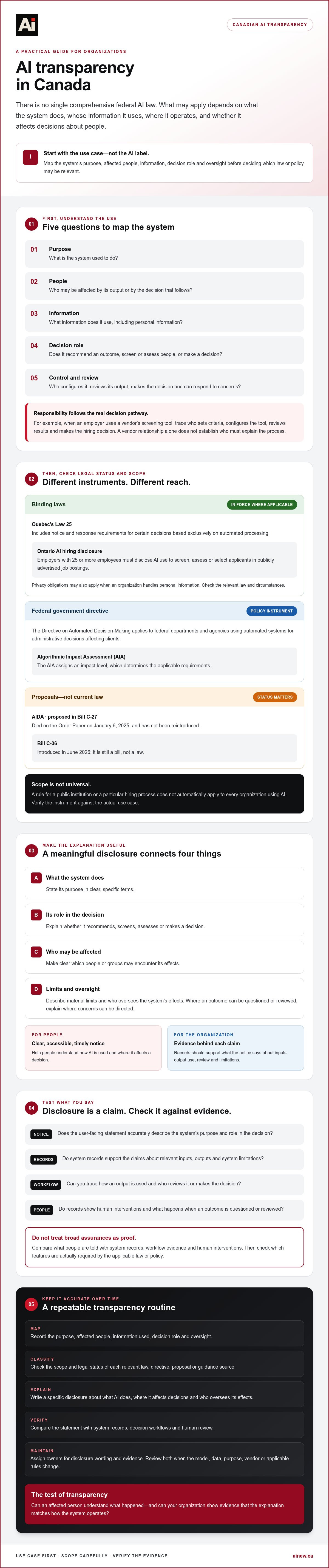
This guide helps you identify which legal or policy instrument may apply to a specific use case, distinguish binding requirements from proposals and guidance, and decide what evidence to inspect. You’ll learn how to check system records, decision workflows, and user-facing notices, then turn broad transparency claims into disclosures that can be tested and reviewed. Start with the use case, not the label attached to the technology. The relevant obligation depends on how the system operates and whom it affects.
Key Takeaways
- Identify the system’s purpose, affected people, data, and role in a decision before assessing which transparency obligations may apply.
- Use ai transparency requirements canada as a starting point, then check each instrument’s scope and legal status against your organization’s actual use case.
- Make disclosures specific enough to explain what the AI does, where it affects a decision, and who can review or challenge the result.
- Compare user-facing statements with system records, workflow evidence, and human interventions. Broad assurances aren’t proof of how a system operates.
- Assign owners for disclosure wording and supporting evidence, and review both when the model, data, purpose, vendor, or applicable rules change.
Table of Contents
- AI Transparency in Canada: Impact on Your Organization
- Which Canadian AI Transparency Rules Apply, and Which Are Still Proposals?
- What Evidence Makes an AI Transparency Disclosure Meaningful?
- How Can You Test Whether Your AI Transparency Is Accurate?
- How Should Canadian Teams Put AI Transparency Into Practice?
AI Transparency in Canada: Impact on Your Organization
Transparency means giving people clear, accurate information about how an AI system is used, what role it plays, what its limits are, and who oversees its effects. It is not a product label or a general promise to use AI responsibly. A meaningful explanation connects the system’s actual operation to the people and decisions it may affect.
There is no single Canadian AI transparency law that applies to every use. The relevant obligations depend on factors such as the organization’s role, the decision being made, the information involved, the sector, and the governing law or policy. The proposed Artificial Intelligence and Data Act, part of Bill C-27, died on the Order Paper on January 6, 2025, and has not been reintroduced. Canada's Artificial Intelligence and Data Act (AIDA) provides broad background on the policy context. Use current legislation and official guidance to verify what applies to a specific use.
Who may need to explain an AI system?
Start by separating the roles. Public institutions may be subject to rules for government decision-making, while private organizations may have obligations under privacy, employment, or other laws. Developers build or adapt systems, deployers put them to use, and service providers may supply tools or data. These labels don’t settle responsibility. A contract may assign tasks one way, while actual control over the system or decision rests elsewhere.
Trace the decision pathway. If an employer uses a vendor’s tool to screen applications, identify who chooses the screening criteria, configures the tool, reviews its output, and makes the hiring decision. The vendor’s role matters, but it doesn’t by itself establish who must explain the process to applicants. This is a practical way to map responsibility, not a universal legal test.
What does transparency need to make understandable?
Make the explanation concrete. A person should be able to understand the system’s purpose, whether it recommends or makes a decision, who may be affected, and any material limits that could change how its output should be interpreted. If an outcome can be questioned or reviewed, the information should help the person understand what happened and where to direct a concern. The specific information required by law varies by instrument and context.
Separate the public-facing disclosure from the internal evidence behind it. A notice may describe the system’s function and role in a decision; records should support those claims, including relevant inputs, how outputs are used, human review, and system limitations. Test whether the disclosure is clear, accessible, and provided at a useful time, then verify whether the applicable law or policy makes any of those features a legal duty. That distinction is central to assessing ai transparency requirements canada without overstating what the rules require.
Which Canadian AI Transparency Rules Apply, and Which Are Still Proposals?
Classify the instrument before drawing conclusions. As of September 2026, Canada has no single comprehensive federal AI statute in force. The rules that may matter instead come from privacy legislation, targeted provincial requirements, federal government policy, proposed bills, and voluntary guidance. Their scope differs. A rule for a public institution or a particular hiring process doesn’t automatically apply to every business using AI.
- Binding laws: Privacy obligations may apply when an organization handles personal information. Quebec’s Law 25 includes notice and response requirements for certain decisions based exclusively on automated processing. Ontario employers with 25 or more employees must disclose AI use to screen, assess, or select applicants in publicly advertised job postings.
- Government directive: The federal Directive on Automated Decision-Making applies to federal departments and agencies using automated systems for administrative decisions affecting clients. Its Algorithmic Impact Assessment (AIA) assigns an impact level that determines applicable requirements.
- Proposals: AIDA, proposed in Bill C-27, died on the Order Paper on January 6, 2025, and has not been reintroduced. The federal government’s proposed Artificial Intelligence and Data Act (AIDA) page explains the former proposal, not current law. Bill C-36, introduced in June 2026, remains at first reading. Its proposed transparency, explanation, and human-review rights are not yet legal requirements.
- Voluntary guidance: Strategies, recommendations, and internal policies can inform practice, but don’t become binding law simply because an organization adopts or cites them.
How do privacy laws relate to AI transparency?
AI-specific legislation isn’t the only route to obligations. If a system collects or uses personal information, the applicable privacy regime may govern that handling, even where no AI-specific statute applies. PIPEDA covers certain private-sector activities, including commercial activity across provincial or national borders; provincial privacy laws may govern activities within a province. Quebec, Alberta, and British Columbia have private-sector privacy laws recognized as substantially similar for relevant intra-provincial activity. Check the organization, data flow, and activity rather than assuming one rule applies nationwide. For a closer privacy-law review, use a dedicated PIPEDA and AI guide alongside current legal sources.
When does the federal automated decision-making directive matter?
Check whether the organization is a federal department or agency and whether the system supports an administrative decision affecting a client. The Directive is not a private-sector rule. Federal institutions use the mandatory AIA to determine an impact level, which shapes requirements for transparency, oversight, peer review, and explanations. Consult the current directive and AIA instructions before relying on an older summary. For practical context, explore Canadian AI policy guides and analyses. Treat them as educational resources, not legal certification.
What Evidence Makes an AI Transparency Disclosure Meaningful?
A notice that says “we use AI” identifies a technology category, not what happens to a person’s information or outcome. A meaningful disclosure names the system’s function, the stage where it is used, and the people who may be affected. It should distinguish whether the system generates content, recommends an action, ranks options, or contributes to a decision made by a person.
A useful AI disclosure is specific, current, and traceable to evidence. That is a practical test, not a claim that every element is required by every Canadian law. The applicable statute, directive, or policy determines the legal duty. A proposal for an AI Transparency Act offers a perspective on stronger transparency rules, but a proposal is not itself a legal requirement.
What should a public-facing AI notice explain?
Write for the person affected, not just the system owner. Explain the purpose, the AI’s material role in the process, and limitations that could affect how its output should be interpreted. Where applicable, explain how a person can ask a question, seek review, or raise a concern. Use plain language: “The tool ranks applications for staff review” is more informative than “AI supports decision-making.”
Be precise about uncertainty. Don’t describe a system as fully autonomous if staff review its recommendations, and don’t imply that an output is always accurate. Test the notice for clarity, accessibility, and timing, then check the governing instrument to determine whether those features, or a particular explanation or review route, are legally required in that situation.
Which internal records support transparency claims?
Public wording is only the visible layer. Keep records that let an accountable reviewer compare each statement with system operation. A practical evidence set may include:
- System inventory: the tool’s purpose, owner, supplier, and uses.
- Data-flow records: what information enters, where it moves, and how it is used.
- Version history: changes to the model, settings, data, or intended use.
- Testing results: documented performance checks and known limitations.
- Approval records: who authorized the use, notice wording, and review process.
Assign an owner and evidence source to each public claim. If a notice says a person reviews recommendations, the workflow and review records should show who does that work and how they can act on the output. A generic AI notice proves none of this. It cannot establish accuracy, meaningful oversight, or an effective review process on its own.
For technical logging methods, consult an AI audit-trail guide and use it to develop records that support your own claims. The goal is not to collect paperwork for its own sake. It is to make the disclosure verifiable when the system or process changes.
How Can You Test Whether Your AI Transparency Is Accurate?
Turn each disclosure into a claim that can be checked against how the system actually operates. A repeatable review follows the use from its purpose and governing rules through the evidence and public wording, then records who owns any gap. A disclosure is only as reliable as its evidence trail.
Use this sequence:
- Map the use: Record what the system is intended to do, who uses it, who may be affected, which data categories it handles, and what consequences may follow.
- Identify the rules: Determine the organization’s role and check the current law, policy, contract, and sector requirements that may govern this use.
- Inspect the evidence: Trace inputs, transformations, outputs, human interventions, and the person or body responsible for the final decision.
- Test the statements: Compare each public claim with system documentation, settings, testing, and observed behaviour.
- Assign ownership: Record gaps, corrective actions, accountable owners, and a date for review.
How do you map the system and applicable duties?
Be specific about the decision pathway. For a system that helps allocate service requests, for example, record what information it receives, how it sorts or recommends cases, who sees the output, and whether a person can change the result. Then identify the organization’s actual role. The organization operating the tool, the supplier, and the decision-maker may not be the same party.
Check scope before treating a rule as applicable. Confirm the relevant jurisdiction, type of organization, information, decision, and governing instrument. If the legal interpretation remains uncertain, escalate it to qualified counsel. This guide supports practical assessment, but it isn’t legal advice.
How do you check the disclosure against system behaviour?
Test statements against representative cases, including ordinary use and situations where known limits may matter. If a notice says the system only recommends an outcome, inspect production settings and workflow records to confirm it doesn’t automatically finalize the decision. If it describes a human review, verify that the reviewer has authority, receives the relevant information, and records what they did. A nominal human step is not proof of meaningful review.
Compare claims about capability, accuracy, or fairness with documented testing and observed outputs. If the evidence doesn’t support a claim, narrow or remove it. Don’t imply performance across circumstances that haven’t been tested. Log the finding, owner, corrective action, and review date. An AI risk-assessment checklist can help organize this work and preserve a usable evidence trail.
Repeat the review when the system’s purpose, data, configuration, or decision workflow changes. This helps keep ai transparency requirements canada statements aligned with current operation, rather than relying on wording approved for an earlier version.
How Should Canadian Teams Put AI Transparency Into Practice?
Make transparency part of system ownership, not a notice drafted once and left untouched. Assign people to maintain the inventory, approve disclosure wording, retain supporting evidence, schedule reviews, and escalate incidents. The ai transparency requirements canada teams need to address depend on the use and applicable rules. Clear ownership helps keep evidence and public statements aligned as those details change.
- Inventory owner: records each system’s purpose, users, and accountable business area.
- Disclosure owner: checks wording against actual system behaviour and applicable requirements.
- Evidence owner: maintains records and controls access to them.
- Review owner: coordinates scheduled checks and reassessment after changes.
- Escalation owner: routes incidents, inaccurate notices, or unexplained outcomes to the right decision-makers.
Keep legal interpretation distinct from operational testing. Qualified legal advice can help determine which laws or policy instruments apply; technical and process reviews establish whether the system behaves as described. Neither check replaces the other. Set review triggers for material changes to the model, data, purpose, vendor, decision process, or relevant legal requirements. Record who assessed the change, what they found, and whether the disclosure or controls need revision.
What should a maintainable transparency record contain?
Keep a dated record of the system’s purpose, accountable roles, applicable instruments, disclosure version, and evidence supporting each material statement. Add known limitations, review decisions, changes, unresolved issues, and the reason for each update. Restrict access and set retention practices according to the information’s sensitivity and applicable requirements. Don’t assume one retention period or access rule suits every record.
Make the record usable. A reviewer should be able to move from a public statement to its evidence, identify who approved it, and see whether later changes triggered a review. If a limitation remains unresolved, document the decision to continue, pause, or change the use, and who authorized that decision.
Where can teams continue their research?
Use a Canadian AI glossary to clarify terminology and a national resource directory to locate relevant materials. The Learning Lab can support hands-on educational testing; it doesn’t replace legal analysis or organization-specific review. AI New Canada’s practical guides and Canadian policy analysis offer a next step for teams building their own evidence trail, not legal certification or custom implementation.
Explore AI New Canada’s practical guides and policy analysis to examine how your disclosures match the systems your organization uses.
Make Every AI Disclosure Verifiable
Effective transparency starts with the use case, not a generic notice. Identify who is affected, determine which law or policy may apply, and keep proposed rules distinct from current obligations. Then connect each public statement to evidence about system behaviour, human involvement, and known limitations.
That process turns ai transparency requirements canada from a broad policy question into a practical review: map the decision, verify the evidence, test the wording, and assign owners to maintain the record. Revisit the disclosure when the system, its purpose, its data, or the rules change. Legal interpretation and operational testing should work together, but neither can stand in for the other.
For continued learning, AI New Canada offers independent Canadian policy analysis and open-access guides, checklists, privacy-tracing tools, and learning resources. Explore AI New Canada’s practical guides and policy analysis to support your own review and evidence-building. Start with the relevant guide or checklist, then use it to map your system, identify supporting records, and test whether each disclosure matches how the system works.
Frequently Asked Questions
Is there one AI transparency law that applies across Canada?
No. Canada’s AI transparency requirements depend on the organization, the system’s use, the information involved, and the applicable law or policy. Privacy laws, targeted provincial rules, and federal government directives cover different situations; they don’t create one nationwide rule for every AI use. AIDA, the proposed federal AI law in Bill C-27, died on the Order Paper on January 6, 2025, and hasn’t been reintroduced.
What does Canadian law require organizations to disclose when they use AI?
There’s no universal disclosure duty triggered by every use of AI. Requirements depend on the applicable instrument and facts. For example, Quebec’s Law 25 requires notice when personal information is used for a decision based exclusively on automated processing. Ontario employers with 25 or more employees must disclose AI use to screen, assess, or select applicants in publicly advertised job postings. Check the rule’s scope before applying it to your organization.
Does PIPEDA require businesses to tell people when AI is used?
PIPEDA doesn’t create a blanket requirement to notify people every time a business uses AI. It may apply when a private-sector organization handles personal information in commercial activities within its scope, and its privacy obligations may be relevant to the system’s data practices. Other federal or provincial rules may add requirements in particular circumstances. Map the information, activity, and jurisdiction, then check current legal guidance before deciding what notice is required.
Does the federal Directive on Automated Decision-Making apply to private companies?
No. The Directive applies to federal departments and agencies using automated systems for administrative decisions affecting clients; it doesn’t directly govern private companies. Federal institutions use the mandatory Algorithmic Impact Assessment to determine an impact level, which informs applicable transparency and oversight requirements. A private organization working with government should check its contract and the institution’s requirements, but that relationship doesn’t automatically make the Directive a private-sector law.
Is Canada’s proposed Artificial Intelligence and Data Act currently in force?
No. The Artificial Intelligence and Data Act, or AIDA, was proposed as part of Bill C-27. The bill died on the Order Paper on January 6, 2025, and AIDA hasn’t been reintroduced as of September 2026. Don’t treat summaries of its proposed requirements as current legal duties. Check the status of any later legislation or bill against authoritative government and parliamentary records before relying on it.
Can people ask for an explanation of an AI-assisted decision in Canada?
Sometimes, depending on the law and how the decision was made. Under Quebec’s Law 25, when a decision about a person is based exclusively on automated processing of personal information, the person can request information about the data used, the reasons and principal factors behind the decision, and their right to correct information. They must also have an opportunity to submit observations to a staff member able to review it. Other contexts differ.
What records should an organization keep to support an AI transparency notice?
Keep records that let a reviewer check each material statement against the system’s actual use. These may include a system inventory, data-flow information, model or configuration version history, testing results, known limitations, approval records, and documentation of human review. Record who owns each disclosure and evidence source, along with updates and review decisions. Set access and retention practices according to the information’s sensitivity and applicable requirements, rather than keeping records indiscriminately.
See something we should fix? Read the corrections policy or tell the newsroom.