
Editorial note: This AI-generated article was manually copied from AutoSEO. Its wording and cited links are preserved. It has not completed AI New Canada’s source review and remains outside search promotion. Check current primary sources before relying on legal or policy claims.
A polished AI demo can make a weak result look convincing. If you’re searching “ai learning lab canada,” the useful question isn’t just what a model can do. It’s how to test its output, record what happened and judge what the evidence actually supports. Tutorials often show a feature, not its failure, and a demonstration alone can’t establish that a tool is suitable for workplace use.
It’s reasonable to want practical learning without putting sensitive information at risk or mistaking an exercise for proof. This article explains what an AI learning lab can help you examine, what its limits are and how to approach a test using controlled tasks and clear records. You’ll learn how to compare outputs, note the prompts and conditions that shaped them, and identify where human review is still needed. We’ll also connect hands-on learning to the Canadian context, where organizations need to assess AI claims against their own responsibilities and circumstances. The aim is not to endorse a tool or certify compliance. It’s to help you make a better-informed next decision.
Key Takeaways
- Use an AI learning lab to examine model behaviour through practical tasks, not to treat a demonstration as proof.
- Follow a repeatable test process: define a question, set a baseline, keep conditions consistent and record the outputs.
- Choose between a course, demo, sandbox, lab or formal assessment by clarifying what evidence and next step you need.
- For an ai learning lab canada, check the current activities, access process and prerequisites before deciding whether it fits your role.
- Separate privacy questions from performance questions, and set clear boundaries for materials, participant roles and review.
Table of Contents
- What Is an AI Learning Lab in Canada, and What Can It Help You Test?
- How to Learn by Testing AI: A Repeatable Lab Workflow
- AI Learning Lab vs. Course, Sandbox or Formal Assessment: How to Choose
- How to Run a Responsible AI Learning Exercise in a Canadian Organization
- Explore the AI New Canada Learning Lab: What to Check Before You Start
What Is an AI Learning Lab in Canada, and What Can It Help You Test?
An AI learning lab is a structured setting where people examine AI through practical tasks, changing conditions and observed outputs. The goal isn’t simply to see a tool work. It’s to ask a focused question, inspect the result and consider what the evidence does and doesn’t support.
A learning lab is a guided space for testing AI behaviour through practical exercises. Unlike a course, it centres on participant investigation. Unlike a product demonstration, it doesn’t treat a prepared example as proof of reliability.
Professionals, developers, policy staff and teams assessing possible AI uses may all benefit. A beginner might examine how a prompt affects a simple response. An intermediate user might compare outputs against defined evaluation criteria. The format can help people in different roles build a shared understanding of what was tested and what remains uncertain.
The word “lab” can also describe a research institute. For example, Mila, the Quebec AI Institute is a Canadian AI research institute, not a synonym for a practical learning exercise. Check what a specific resource means by “lab” before assuming its activities, access or intended audience.
How an AI learning lab differs from a course or demonstration
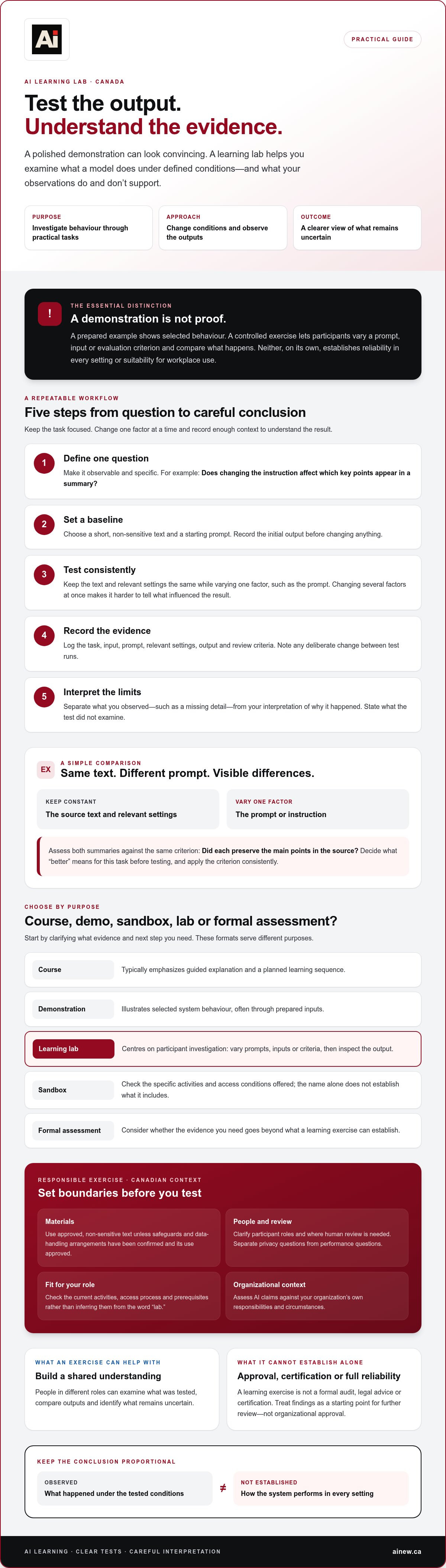
A course typically emphasizes guided explanation and a planned learning sequence. A demonstration illustrates selected system behaviour, often through prepared inputs. In a learning lab, participants can vary prompts, inputs or evaluation criteria and observe whether the output changes. Each format serves a different purpose: a demo can introduce a tool, while a lab can help participants investigate a question. Neither format alone establishes that a system is reliable in every setting.
For example, participants could compare summaries of the same non-sensitive text using different prompts, then note differences in accuracy, omissions or emphasis. A demonstration may show one summary. Repeating a controlled task makes the comparison visible. Keep the conclusion narrow: results from an exercise describe the tested conditions, not every possible use.
Who can use an AI learning lab, and what should they bring?
You don’t need to assume a particular technical background. Beginners can bring a learning objective; more experienced participants can bring a work question or a testable hypothesis. Before starting, check the lab’s stated activities and prerequisites rather than inferring them from its name.
Set boundaries for the materials you use. Choose approved, non-sensitive text unless the lab’s safeguards and data-handling arrangements have been confirmed. A learning exercise supports understanding and experimentation; it isn’t a formal audit, legal advice or certification. Treat its findings as a starting point for further review, not as organizational approval.
How to Learn by Testing AI: A Repeatable Lab Workflow
A useful test starts with a question you can answer by observing the system, not a broad claim such as “Is AI good at summarizing?” In an ai learning lab canada exercise, define the conditions first and keep a record that lets someone else understand what you did. The steps below suit a small learning task; they don’t turn it into a full system evaluation.
- 1. Define one question. Make it specific: “Does changing the instruction affect which key points appear in a summary?”
- 2. Set a baseline. Choose a short, non-sensitive text and a starting prompt. Record the initial output before changing anything.
- 3. Test consistently. Keep the text and relevant settings the same while you vary one factor, such as the prompt. If you change several factors at once, you won’t know which one influenced the result.
- 4. Record the evidence. Log the task, input, prompt, relevant settings, output and review criteria. Note any deliberate change between test runs.
- 5. Interpret the limits. Separate what you observed, such as a detail missing from one summary, from your interpretation of why it happened. Identify what the test didn’t examine.
Set up a focused AI experiment
Use the same text to compare two prompts, then assess both summaries against a simple criterion: did each preserve the main points in the source? Apply the criterion consistently and don’t add new requirements halfway through. Use approved, non-sensitive material. Don’t enter personal, confidential or restricted information unless the lab’s safeguards have been verified and its use approved.
Before testing, decide what “better” means for this task. A shorter summary may be easier to scan but omit qualifications; a longer one may retain detail without being clearer. State the trade-off you’re examining so that a preference isn’t presented as a finding.
Record results without overstating what they prove
Where practical, repeat a test and record variations instead of selecting only the most convincing output. Note inconsistent results and preserve enough detail to distinguish a change in the model’s response from a change in your input or settings.
One successful output shows that a system produced that result under those conditions. It doesn’t establish reliability across tasks, users or settings. A small exercise can reveal useful questions and possible failure points, but it can’t establish universal performance. For public-sector context on responsible use, consult the Government of Canada’s Responsible use of AI in government resource. For practical, Canadian-focused learning, explore AI New Canada’s AI learning resources.
AI Learning Lab vs. Course, Sandbox or Formal Assessment: How to Choose
Choose a format that matches the decision you need to make. A course builds knowledge; a lab lets participants examine outputs from a bounded task; a formal organizational assessment supports decisions that require accountable review beyond a learning exercise. For an ai learning lab canada search, this distinction matters: trying a tool is not the same as deciding whether an organization should use it.
| Format | Purpose | Participant activity | Evidence produced | Appropriate next step |
|---|---|---|---|---|
| Course | Build foundational knowledge or follow a sequenced curriculum | Study concepts and complete planned lessons | Learning notes or completed exercises | Apply the concepts to a bounded question |
| Tool demonstration | Illustrate selected features or behaviour | Observe prepared examples | Examples shown under demonstration conditions | Test relevant claims independently |
| Learning lab | Practise a task and inspect system outputs | Vary inputs or criteria and compare results | Task records, outputs and observations | Identify what needs further testing or review |
| Open sandbox | Explore a tool with fewer prescribed steps | Experiment more freely | Self-directed notes and outputs, if recorded | Structure a controlled test before drawing conclusions |
| Formal organizational assessment | Inform an accountable decision about organizational use | Review the intended use, evidence, risks and controls through relevant internal processes | Decision records and assessment materials defined by the organization | Proceed, revise or decline use through authorized governance |
Choose a format based on the decision you need to make
If people need foundational instruction, choose a course. If they need to practise a specific task and inspect actual outputs, a lab is a better fit. An open sandbox allows exploration, but less structure can make comparisons harder unless participants set and record consistent conditions. A demo can orient learners, but prepared examples don’t independently establish reliability. When the organization must make an accountable decision, use its formal review process. A lab can inform that work, not replace it.
Keep Canadian policy context separate from legal conclusions
Canadian policy references can help frame questions, but they don’t turn an exercise into a compliance review. The Treasury Board of Canada Secretariat’s Directive on Automated Decision-Making and its Algorithmic Impact Assessment are government instruments with a defined context and scope, not generic worksheets for every organization. Check current official wording and applicability before relying on them. Don’t infer that an exercise meets a legal or policy obligation.
For broader implementation questions, use practical guides alongside relevant official sources. A guide can help you identify issues to investigate, but it isn’t evidence that a particular tool or use is approved.
How to Run a Responsible AI Learning Exercise in a Canadian Organization
A team exercise needs boundaries before it needs prompts. Decide what participants are learning, what materials they can use and who will review the results. An ai learning lab canada exercise can help a team observe a tool under defined conditions, but it doesn’t settle privacy obligations, establish organizational approval or prove that a system is fit for use.
Set boundaries before testing
Before anyone enters information into a tool, agree on the exercise’s scope and controls. Use this checklist to create a basic record:
- Objective: State the learning question and what the exercise is not intended to decide.
- Ownership and roles: Name a test owner, participants and the person responsible for reviewing observations.
- Tools and approval: Identify the permitted tool and confirm organizational approval before testing.
- Materials: Check internal data-handling rules. If safeguards, retention practices or approval are unclear, use synthetic or public inputs instead of work information.
- Documentation: Decide where the test record will be kept and who can access it.
Keep privacy questions separate from performance questions. Privacy review asks how information is collected, used, retained or disclosed, and whether its use is authorized in the organization’s context. Performance review asks whether the output meets defined criteria, where it fails and how results vary. A sound answer to one doesn’t answer the other.
Where personal information or a relevant organizational activity is involved, consult current guidance from the Office of the Privacy Commissioner of Canada and consider whether the federal Personal Information Protection and Electronic Documents Act (PIPEDA) applies. Applicability depends on context; a learning exercise is not a legal determination. Confirm requirements with appropriate organizational or legal specialists rather than treating a lab result as a conclusion.
Turn observations into an accountable record
Document enough detail for a reviewer to understand what was tested and observed. Record the test date, tool or system description, task, input, relevant settings, output and review criteria. Add reviewer observations, unexpected results and any changes made between test runs. Separate direct observations from interpretations, and flag unresolved questions for the appropriate specialist.
Keep the conclusion proportional to the exercise. A limited test can identify issues to investigate; it can’t establish performance across different users, tasks or conditions, and it isn’t a certification or formal audit. For a broader team review, use the AI Risk Assessment Checklist for Canadian Teams as a next-step resource, then follow your organization’s own review process.
Explore the AI New Canada Learning Lab: What to Check Before You Start
AI New Canada is an independent Canadian publication offering plain-language AI policy analysis and practical learning resources. Its offerings include a Learning Lab, practical guides, policy briefs and testable examples. These resources can complement one another: a guide can introduce a topic, while a hands-on exercise gives you a way to examine AI behaviour. Check the current details before assuming the lab supports a particular task or skill level.
If you’re considering an ai learning lab canada resource, start by checking what it asks you to do. The label “learning lab” doesn’t tell you whether activities are guided, what materials are supplied or whether a particular tool is required. Confirm those details on the live site before setting aside time or preparing an exercise.
Check the lab’s scope, activities and prerequisites
Review the current description for practical details that determine whether the resource suits your goals:
- Activities: What tasks does the lab support? Are instructions or sample materials provided?
- Access: Does participation require an account or particular tools? Check the current access process rather than assuming.
- Preparation: Are prerequisites or prior technical knowledge stated? If the page is unclear, don’t infer the expected skill level.
- Boundaries: Is the activity educational? Don’t treat a learning exercise as individualized legal advice, a compliance review or certification.
These checks matter because an exercise’s value depends on its scope. A task that helps you inspect one type of output may not answer a different question about organizational risk or suitability. Keep the intended decision modest, and identify what would require a separate review.
Choose a first exercise and continue learning
Start with one bounded question that fits your role, such as whether an AI tool preserves key details in a short, public text. Use a non-sensitive example, note the task and review the result against a clear criterion. If the exercise raises unfamiliar terminology, consult the Canadian AI Glossary as a reference rather than guessing at a term’s meaning.
Then connect what you observed to the broader context. Practical guides and policy briefs can help frame questions raised by an exercise, while testable examples can offer another way to examine AI behaviour. None should be treated as proof that a tool is suitable for your organization. Keep the evidence, uncertainty and next question distinct.
Check the current scope and participation details, then Explore AI New Canada’s Learning Lab as a practical next step in your Canadian AI learning.
Make Your Next AI Test More Deliberate
A useful ai learning lab canada exercise turns a claim into a bounded question, holds test conditions steady and records what the system actually produces. That record helps distinguish observed behaviour from interpretation, but it doesn’t establish that a tool is reliable in every context or replace an organization’s formal review.
Choose the learning format that fits your decision. A course can build foundational knowledge; a lab can provide hands-on practice; an organizational assessment is needed for accountable decisions beyond an exercise. Keep privacy questions separate from performance questions, and use approved materials with clear boundaries.
AI New Canada is an independent Canadian publication and research resource, with practical guides, testable examples and hands-on learning resources. Its plain-language analysis connects evidence with real-world application and supports further exploration without treating a demonstration as proof.
Start with one question that matters to your role, then check the current activities and participation details before you begin. Explore AI New Canada’s Learning Lab and take your next step with a test you can explain, document and review.
Frequently Asked Questions
What is an AI learning lab?
An AI learning lab is a structured setting for examining AI through practical tasks. Participants work with a defined question, observe system outputs and consider what those results show under the tested conditions. Unlike a course, which generally centres on instruction, a lab emphasizes hands-on investigation. It can support learning and experimentation, but its findings aren’t automatically a formal audit, legal opinion or proof of reliability.
Is there an AI learning lab in Canada for beginners?
AI New Canada lists a Learning Lab among its practical Canadian AI learning resources, but check its current site for activities, access details and prerequisites before assuming it suits beginners. A useful ai learning lab canada resource should make its scope clear. If you’re new to AI, start with a learning objective and confirm whether the activity provides instructions or expects prior technical knowledge.
Can I use real personal information in an AI learning lab?
Don’t enter real personal information unless your organization has approved its use and you’ve verified the lab’s safeguards and data-handling practices. A lab exercise alone doesn’t establish that information will be protected or handled appropriately. Use synthetic or public material when the rules are unclear. If personal information is relevant, consult your organization’s privacy process and appropriate specialists before testing.
How do you test an AI system in a learning lab?
Start with one answerable question, then set a baseline using an approved, non-sensitive input. Keep the input and relevant settings consistent while changing one factor, such as the prompt. Record each output and compare it against stated criteria. For example, test whether summaries retain key points from the same public text. This method supports a focused ai learning lab canada exercise, not a universal reliability claim.
Does an AI learning lab certify that a system is compliant in Canada?
No. A learning lab is for education and practical investigation; it doesn’t provide formal legal compliance certification. An exercise may help identify questions about a system’s outputs or use, but it can’t determine whether an organization meets applicable legal or policy requirements. Keep the conclusion limited to what was tested, and refer compliance questions to qualified legal or organizational specialists using current, relevant sources.
What is the difference between an AI learning lab and an AI sandbox?
A learning lab is generally organized around a learning objective or bounded task, with participants examining what the system produces. An open sandbox usually allows more self-directed exploration, which can be useful for trying tools but may offer less structure for comparing results. The labels aren’t standardized, so check the actual activities, controls and documentation expectations before deciding which format fits your purpose.
What should I record during an AI lab exercise?
Record the test date, task or question, tool description, input, prompt, relevant settings, output and review criteria. Note any deliberate changes between runs, who reviewed the results and what they observed. Separate direct observations from interpretations, and flag unexpected outputs or unresolved questions. This record helps others understand the exercise, but it doesn’t turn a limited learning activity into a formal assessment.
See something we should fix? Read the corrections policy or tell the newsroom.